

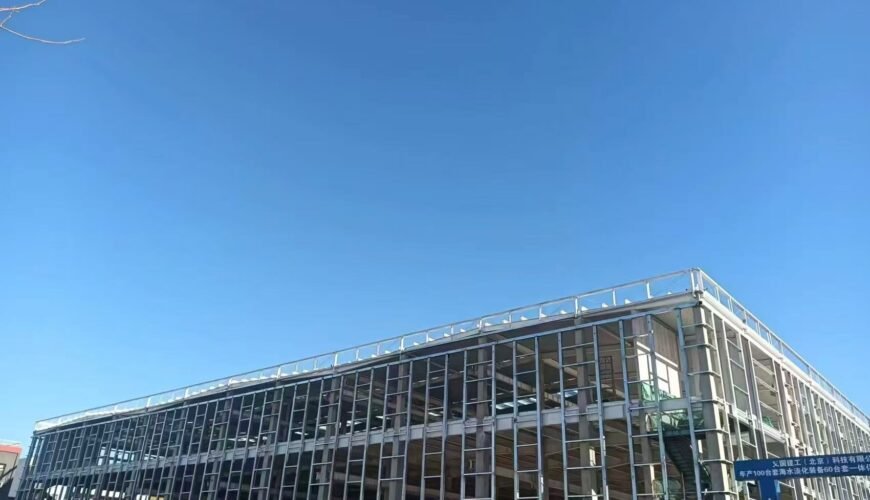
In the dynamic world of modern construction, efficiency, strength, and adaptability are paramount. This is where the portal steel frame emerges as a cornerstone of contemporary design, offering a robust and versatile structural solution for a vast array of projects. Characterized by its clear-span capability and efficient use of material, this engineered system utilizes rigid connections between columns and rafters to create expansive, column-free interiors. Its inherent benefits—from rapid on-site assembly and cost-effectiveness to exceptional durability and design flexibility—make it an indispensable choice for architects and engineers. From vast warehouses and industrial facilities to agricultural buildings and commercial complexes, the portal steel frame provides the skeletal backbone for the ambitious structures that define our built environment.
Understanding Portal Steel Frame Structures and Their Core Components
Understanding Portal Steel Frame Structures and Their Core Components
A portal steel frame is a highly efficient structural system, characterized by its clear-span, rigid-jointed framework. It forms the primary skeleton for a vast range of single-story buildings, from warehouses and factories to aircraft hangars and retail complexes. The system’s fundamental principle lies in its moment-resisting connections, where columns and rafters are rigidly joined to create stable, rectangular portals that transfer loads directly to the foundations. This design eliminates the need for internal columns, maximizing usable floor space and offering unparalleled flexibility for interior layouts.
The core components of a portal frame work in a highly integrated manner to ensure structural integrity and performance.
Primary Structural Elements:
- Rafters: The main horizontal or sloping members that form the roof structure. They span between portal frames and support roof cladding and services.
- Columns: The vertical members that support the rafters and transfer loads to the foundation. In portal frames, they are designed to resist both axial forces and bending moments.
- Eaves Haunches: Critical reinforced sections at the junction of the column and rafter. The haunch significantly increases the frame’s moment capacity at this high-stress connection, allowing for more slender and economical main members elsewhere.
- Apex: The highest point where two rafter sections meet. This connection is also rigid, completing the portal loop.
Secondary Elements & Connections:
- Purlins and Side Rails: These cold-formed Z or C sections span between primary frames. Purlins support the roof cladding, while side rails support wall cladding. They provide lateral restraint to the rafters and columns.
- Bracing: Essential for overall stability, bracing systems (including diagonal rods or cables in the roof and walls) resist longitudinal forces like wind and crane surges, ensuring the structure acts as a cohesive unit.
- Base Plates and Foundations: The column bases are securely anchored via base plates to concrete foundations, designed to resist vertical loads, horizontal shear, and the overturning moments induced by the frame’s rigidity.
The synergy between these components—where rigid joints create frame action, secondary members provide lateral support, and bracing ensures overall stability—is what makes the portal frame a cornerstone of cost-effective, flexible, and rapid modern construction.
Key Advantages of Portal Steel Frames in Industrial and Commercial Projects
Key Advantages of Portal Steel Frames in Industrial and Commercial Projects
The selection of a structural system is a foundational decision in industrial and commercial construction. Portal steel frames have become the predominant solution for warehouses, factories, retail units, and agricultural buildings due to a compelling combination of engineering efficiency and economic pragmatism. Their advantages stem from a clear-span design that eliminates internal columns, creating vast, unobstructed floor space. This fundamental characteristic unlocks a cascade of benefits critical for modern operations.
Structural and Spatial Efficiency
The inherent strength of fabricated steel sections allows for long spans—typically 20 to 60 meters—without intermediate supports. This maximizes usable floor area, simplifies internal logistics, and provides unparalleled flexibility for machinery layout, storage racking, and future reconfiguration. The lightweight nature of the steel framework reduces foundation loads and costs compared to heavier materials. Furthermore, the system’s components are precision-engineered off-site, ensuring high quality and enabling rapid assembly on-site, which significantly compresses project timelines.
Economic and Operational Superiority
From a total project cost perspective, portal frames offer decisive advantages. The speed of erection reduces labor costs and earlier building enclosure allows follow-on trades to commence work sooner. The design efficiency minimizes material waste. Operationally, the clear-span interior lowers long-term costs by facilitating more efficient space utilization and material handling. The frames also provide excellent support for roof and wall cladding systems, enabling high levels of thermal insulation and airtightness, which reduces energy consumption for heating and cooling.
Adaptability and Durability
Portal frames are highly adaptable to specific project needs. They can be easily designed to accommodate crane systems, mezzanine floors, and varying roof pitches for drainage or aesthetic purposes. The material itself, when properly specified and protected with coatings like galvanizing, offers exceptional durability, requires minimal maintenance, and is non-combustible, enhancing building safety. This combination of flexibility, resilience, and low lifecycle cost makes portal steel framing a robust, future-proof investment for asset owners.
| Advantage Category | Key Benefits |
|---|---|
| Spatial & Functional | Unobstructed clear spans, optimal space utilization, layout flexibility. |
| Economic | Reduced foundation costs, faster construction, lower lifecycle maintenance. |
| Construction | Precision off-site fabrication, rapid on-site assembly, predictable scheduling. |
| Performance | Long-term durability, compatibility with high-performance building envelopes, adaptability for expansions. |
Common Applications and Use Cases Across Various Industries
Common Applications and Use Cases Across Various Industries
The inherent efficiency of portal steel frames—characterized by their clear-span capability, rapid erection, and structural adaptability—makes them a cornerstone solution for a diverse range of industrial and commercial building types. Their application is driven by the universal need for large, unobstructed interior spaces, cost-effective construction, and long-term durability.
In industrial and manufacturing, portal frames are the default structural system. They provide the vast, column-free spaces essential for housing production lines, heavy machinery, and expansive storage areas in warehouses and distribution centers. The design easily accommodates overhead cranes, heavy service loads, and the integration of large bay doors for logistics. Similarly, the agricultural sector relies heavily on portal frames for machinery sheds, grain stores, and livestock buildings, where their clear spans allow for flexible equipment movement and storage, and their durability withstands the challenging environmental conditions of farmsteads.
The commercial and retail landscape extensively utilizes portal frames for big-box retail stores, automobile showrooms, and leisure centers. The ability to create vast, uninterrupted floor plates is critical for these applications, enabling flexible floor plans, prominent product displays, and the installation of large glazed façades to create inviting customer environments. For sports and recreation, the structural form is ideal for constructing indoor tennis halls, swimming pool enclosures, and equestrian arenas, where long spans are necessary for playing fields and spectator areas.
Furthermore, portal frames are fundamental in logistics and transportation, forming the primary structure for freight terminals, aircraft hangars, and bus depots. Their robustness supports the dynamic loads of vehicles and cargo, while their economical wide-span design maximizes operational floor space. In the energy and utilities sector, they are employed in workshops, maintenance buildings, and enclosure structures for power generation equipment, prized for their strength and the ease with which they can be clad with insulated panels for environmental control.
| Industry Sector | Primary Applications | Key Driver for Use |
|---|---|---|
| Industrial & Manufacturing | Factories, Warehouses, Workshops | Unobstructed floor space for processes/machinery |
| Agriculture | Machinery Sheds, Grain Stores, Livestock Buildings | Cost-effective, durable clear-span shelter |
| Commercial & Retail | Big-Box Retail, Showrooms, Leisure Centers | Flexible, column-free commercial space |
| Sports & Recreation | Sports Halls, Swimming Pools, Equestrian Arenas | Long spans for activity and spectator areas |
| Logistics & Transport | Freight Terminals, Aircraft Hangars, Vehicle Depots | Robust, economical enclosure for large vehicles |
| Energy & Utilities | Maintenance Buildings, Plant Enclosures | Strength and adaptability for technical environments |
This widespread adoption across sectors underscores the portal frame’s role as a versatile and economically rational structural solution, meeting the fundamental spatial and performance demands of modern construction.
Design Considerations and Best Practices for Optimal Performance
Design Considerations and Best Practices for Optimal Performance
Achieving optimal performance in a portal steel frame structure requires meticulous attention to design fundamentals and construction execution. The primary goal is to create an efficient, safe, and durable system that leverages the material’s strengths while mitigating its inherent challenges.
Key Design Considerations
The design process begins with a comprehensive analysis of loads. Engineers must accurately account for dead loads, imposed live loads, wind loads (which are particularly critical for large, low-pitch roofs), snow loads, and seismic forces where applicable. The frame’s geometry—span, eaves height, and roof pitch—directly influences member sizing and connection design. A common pitfall is underestimating secondary elements; purlins, side rails, and bracing systems are essential for distributing loads and ensuring overall stability, preventing premature buckling or failure.
Connection design is arguably the most critical aspect. Portal frames rely on moment-resisting connections at the eaves and apex to function as intended. These connections must be detailed to transfer bending moments, shear, and axial forces without excessive deformation. The choice between bolted end-plate connections and welded connections involves trade-offs between fabrication cost, on-site speed, and required stiffness. Furthermore, all connections require robust corrosion protection, as moisture ingress at these junctures can lead to accelerated deterioration.
Implementation Best Practices
Adherence to these best practices ensures the theoretical design is realized in practice:
- Material Specification: Use certified steel with clearly defined yield strength and toughness properties. Specify the correct grade for the environmental conditions and fabrication methods (e.g., suitability for welding).
- Detailing for Durability: Design to avoid moisture traps. Specify appropriate surface preparation and protective coating systems, with particular attention to cut edges and connection areas after fabrication.
- Foundation Design: Portal frames impose significant horizontal thrust at the base. Foundations must be designed to resist overturning and sliding moments. Poor soil-structure interaction is a frequent source of serviceability issues.
- Construction Sequencing: Erection plans must account for frame stability during assembly. Temporary bracing is mandatory until all frames are erected and permanent roof bracing is installed. Never allow an unbraced frame to stand alone under wind load.
- Quality Assurance: Implement rigorous inspection protocols at fabrication and erection stages. Verify weld quality, bolt tightness (using torque or turn-of-nut methods), and alignment before the structure is loaded.
Ultimately, optimal performance is achieved through integrated collaboration between the structural engineer, fabricator, and erector, ensuring every decision from initial concept to final bolt tightening is made with structural integrity and longevity in mind.
Comparing Portal Steel Frames to Alternative Building Systems
Comparing Portal Steel Frames to Alternative Building Systems
Selecting the optimal structural system requires a clear understanding of trade-offs. Portal steel frames offer distinct advantages but must be evaluated against other common systems to determine the best fit for a project’s specific requirements.
Versus Traditional Steel Framing
Conventional steel framing with simple connections and separate bracing systems provides immense flexibility for complex geometries and retrofits. However, portal frames integrate the frame and bracing into a rigid joint system, creating large, column-free internal spaces more efficiently. This makes portal frames superior for clear-span buildings like warehouses, but less adaptable for structures requiring numerous internal walls or highly irregular floor plans.
Versus Reinforced Concrete Framing
Reinforced concrete structures offer excellent thermal mass, fire resistance (inherently), and vibration damping. They are often preferred for high-rise applications and where cast-in-place architectural finishes are desired. Conversely, portal steel frames provide a significantly faster construction timeline due to prefabrication and dry construction methods. They are also lighter, reducing foundation costs, and offer greater potential for future expansion or modification. The choice often hinges on project timeline, site constraints, and lifecycle cost considerations.
Versus Laminated Timber (Glulam) Frames
Glulam portal frames present a strong aesthetic and sustainable alternative, sharing the same clear-span capability. Timber excels in environmental profile (carbon sequestration) and interior ambiance. Steel portal frames, however, provide greater strength-to-weight ratios, allowing for longer spans and heavier load capacities. Steel is also less susceptible to moisture-related dimensional changes, offers superior consistency in material properties, and is non-combustible, which can simplify insurance and regulatory compliance.
| System | Key Advantages | Typical Best Applications |
|---|---|---|
| Portal Steel Frame | Speed of erection, large clear spans, cost-effective for simple volumes, adaptable. | Warehouses, factories, aircraft hangars, retail big-box units. |
| Traditional Steel Braced Frame | Design flexibility, suitability for complex forms and retrofits. | Multi-story buildings, offices, structures with many partitions. |
| Reinforced Concrete Frame | High thermal mass, inherent fire resistance, architectural finish integration. | High-rise buildings, residential towers, structures requiring high acoustic mass. |
| Glulam Timber Frame | Aesthetic appeal, sustainability (biogenic carbon), warm interior finish. | Leisure centers, schools, churches, environmentally focused projects. |
Ultimately, the dominance of portal steel frames in industrial and commercial construction stems from their optimal balance of clear-span space, speed, and economy for standardized building envelopes. The decision matrix should prioritize clear-span requirements, construction schedule, total budget, and specific performance criteria like fire rating or environmental goals.
Frequently Asked Questions
What are the key design considerations for a portal frame to resist high wind loads in coastal regions?
To resist high wind loads, especially in coastal or hurricane-prone areas, the design must focus on increasing the frame’s rigidity and connection integrity. Key solutions include specifying higher-grade steel (e.g., S355 or higher), designing steeper roof pitches (≥10°) to reduce wind uplift, incorporating knee braces or haunches at the eaves for moment resistance, and using rigid base plate connections with substantial holding-down bolts anchored into deep foundations. Secondary bracing systems (rafter bracing, wall bracing) are also critical to transfer lateral loads effectively.
How does the choice between hot-rolled and fabricated cold-formed sections impact portal frame performance?
Hot-rolled sections (like universal beams and columns) offer superior inherent stiffness and load-bearing capacity, making them the default choice for primary frames in large-span buildings (e.g., >25m). Fabricated cold-formed sections, often built-up from plate, allow for highly optimized, tapered shapes that minimize material use for specific bending moment diagrams. The choice impacts deflection control, connection design, and fire performance. Hot-rolled is generally preferred for its predictability and simpler connections, while fabricated sections offer weight and cost savings for engineered, repetitive structures.
What are the most critical connection details in a portal frame, and how are they engineered?
The most critical connections are the eaves and apex joints, where large bending moments and shear forces must be transferred. These are typically engineered as full-strength, rigid connections. Modern practice often uses extended end-plate connections with multiple rows of high-strength friction-grip bolts (e.g., Grade 8.8 or 10.9), designed to develop the plastic moment capacity of the rafter and column. Finite element analysis (FEA) is frequently employed to model stress concentrations, and stiffeners are added to the column web and flange to prevent local buckling and ensure a robust moment-resisting joint.
What foundation systems are best suited for portal frames on poor soil conditions?
On poor soil conditions (e.g., soft clay or peat), deep foundation systems are typically required to counteract the significant horizontal thrust and overturning moments from portal frame action. Piled foundations with a reinforced concrete ground beam connecting the piles are the standard solution. The design must carefully consider the pile cap’s ability to resist horizontal shear and the interaction between the frame’s flexibility and the soil-structure interaction. Alternatively, raft foundations may be used for smaller spans, but they require significant reinforcement and careful analysis of differential settlement.
How is the economic span range for a clear-span portal frame determined?
The economic span range for a standard single-bay portal frame is typically between 15m and 50m. Below 15m, alternative construction (e.g., truss and column) may be more economical. Beyond 50m, the frame’s depth and member sizes increase disproportionately, making other systems like space frames or arches potentially more viable. The optimum span is influenced by roof loading, bay spacing (typically 6-8m), and the cost of steel versus the cost of internal supports. Advanced analysis using optimization algorithms can find the most material-efficient frame shape for a given span.
What are the advantages of using tapered portal frame members versus prismatic sections?
Tapered members, where the section depth increases towards the high-moment regions (eaves and apex), offer significant material savings—often 20-30% compared to prismatic (uniform) sections. This is because the cross-section is optimized to match the bending moment diagram. The main advantage is reduced dead weight and lower material cost. The trade-off is increased fabrication complexity and the need for more sophisticated analysis to account for varying section properties along the member’s length, particularly for lateral-torsional buckling.
How does second-order analysis (P-Delta effect) influence portal frame design?
Second-order analysis is crucial for slender portal frames, as it accounts for the additional moments and deflections caused by the vertical loads acting through the lateral displacement of the frame (P-Delta effect). Ignoring this can lead to an unconservative design, especially for frames with high axial loads in the columns and significant initial sway. Modern design codes (e.g., Eurocode 3) mandate its consideration. Software uses iterative analysis to capture this, often resulting in increased member sizes, particularly in the columns, to maintain stability under combined axial and bending stress.
What are the fire engineering strategies for unprotected steel portal frames?
For large, single-story industrial portal frames, a common strategy is to design for a “natural fire” based on the specific fire load and ventilation of the compartment, rather than using the standard furnace curve. This often demonstrates that the steel temperature remains below critical levels due to the large volume and heat sink effect. If protection is needed, intumescent coatings are used for aesthetic or insurance reasons. The structural design may also utilize the redundancy of the frame and the membrane action of the roof decking to provide additional fire resistance.
How is eaves deflection controlled in long-span portal frames to prevent cladding damage?
Excessive eaves deflection can cause damage to brittle cladding and disrupt drainage. Control is achieved by: 1) Increasing the rafter depth, often using tapered sections. 2) Specifying a pre-camber (deliberate upward deflection) during fabrication to offset a portion of the dead load deflection. 3) Designing the frame for a stricter deflection limit (e.g., span/360 for total load) rather than the typical span/200. 4) Ensuring the purlins and side rails have sufficient flexibility to accommodate frame movement without transferring excessive force to the cladding.
What is the role of bracing in a portal frame building, and can it be eliminated?
Bracing (in the roof plane and wall planes) provides stability by resisting longitudinal forces (e.g., wind, crane surges) and preventing buckling of the primary frame members during erection. While the portal frames themselves resist transverse loads, bracing is essential for overall structural integrity. It can sometimes be reduced or replaced by designing the roof deck and wall cladding as diaphragms (if they have adequate strength and connections are properly detailed). However, a fully “unbraced” design requires rigorous analysis and is typically more expensive due to the need for heavier purlins, side rails, and connections.
How are portal frames analyzed and designed for seismic loads in high-risk zones?
In seismic zones, portal frames are designed for ductile behavior to absorb and dissipate energy. Key measures include: designing connections to remain elastic while allowing for plastic hinges to form in predetermined locations (often at the column bases or in the rafters near the eaves), using capacity design principles to ensure shear failure does not precede bending failure, and specifying stringent detailing requirements for member compactness to prevent local buckling during cyclic loading. Damping systems or base isolation may be incorporated for critical facilities.
What are the sustainability and lifecycle considerations for steel portal frames?
Steel portal frames offer strong sustainability credentials through their high recyclability (over 90% recovery rate), potential for reuse, and lightweight nature reducing foundation material. For optimal lifecycle performance, design for deconstruction (using bolted connections), specify hot-dip galvanizing for corrosion protection in aggressive environments, and consider the thermal performance of the building envelope integrated with the frame. The long, clear spans also provide flexibility for future adaptation and change of use, extending the building’s functional life.


